Edge AI Computing: Bringing Intelligence Closer to the Data
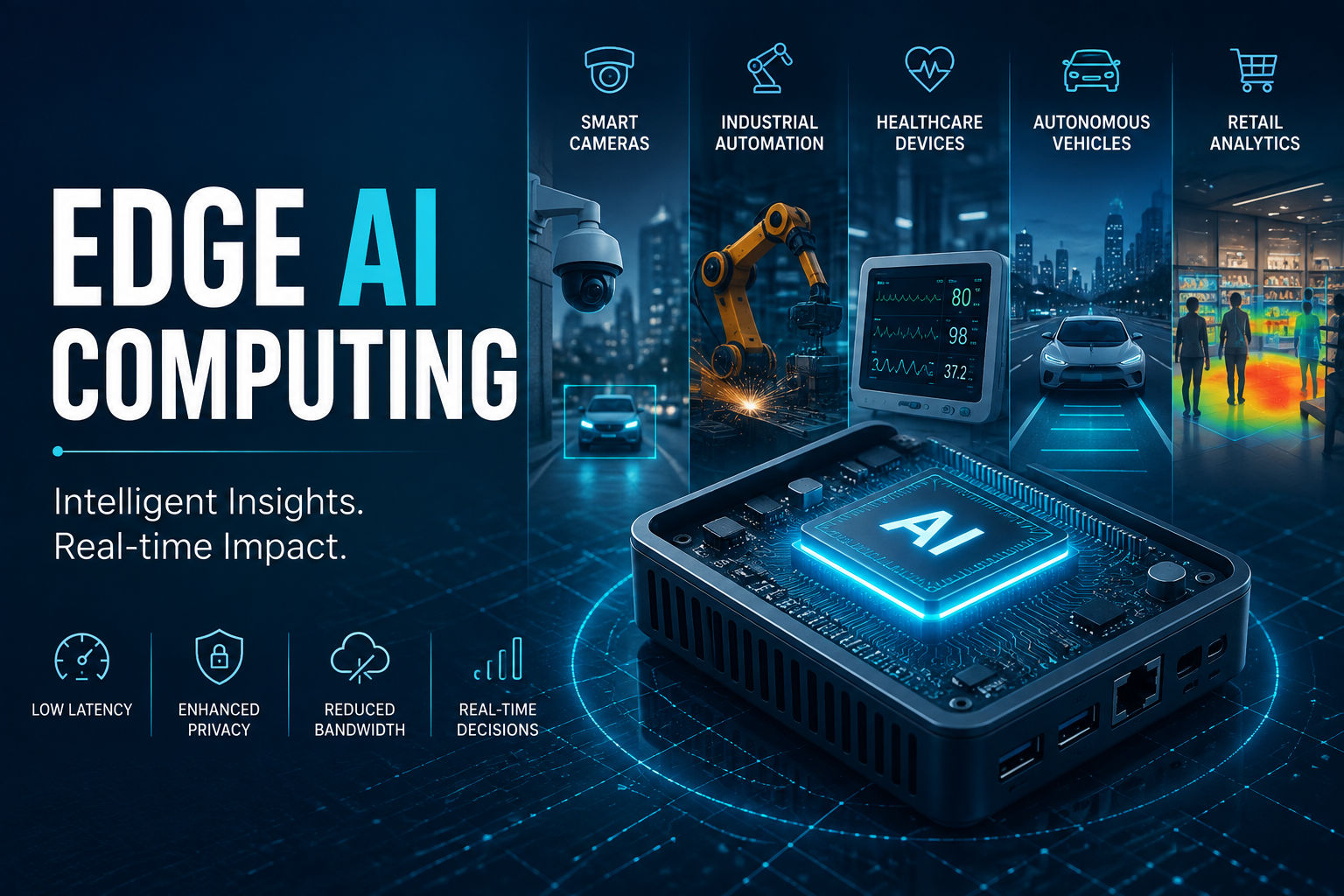
Edge AI Computing: Bringing Intelligence Closer to the Data
Artificial intelligence has traditionally been built around a simple architecture: collect data from devices, send it to a centralized cloud, run an AI model, and return the result.
That architecture works well for many applications. But as the number of connected devices grows, continuously sending raw data to the cloud becomes expensive, slow, and sometimes impossible.
This is where Edge AI Computing comes in.
Edge AI combines edge computing with machine learning inference so that AI models can run closer to where data is generated. Instead of sending every camera frame, sensor reading, audio sample, or industrial measurement to a remote server, the device—or a nearby edge server—can process the data locally.
The result is a different computing model:
Generate data at the edge. Process it at the edge. Send only what matters to the cloud.
What Is Edge AI?
Edge AI is the practice of running AI or machine learning workloads on devices or computing infrastructure close to the source of the data.
The "edge" can be many things:
- A smartphone
- A security camera
- A vehicle
- An industrial gateway
- A Raspberry Pi or similar computer
- A retail store server
- A cellular edge server
- A local GPU server
The important idea is not the specific hardware. It is where inference happens.
A traditional cloud AI application might look like this:
Device
   |
   | Raw data
   v
Internet
   |
   v
Cloud API
   |
   v
AI Model
   |
   v
Prediction
   |
   v
Device
An Edge AI system moves the inference closer to the device:
Device / Sensor
      |
      v
Edge AI Model
      |
      +----> Local action
      |
      +----> Relevant events
                |
                v
              Cloud
The cloud does not necessarily disappear. Instead, it becomes part of a hybrid architecture.
Why Move AI to the Edge?
There are several practical reasons.
1. Lower Latency
Consider an autonomous machine that needs to detect an obstacle.
If the machine sends an image to a remote cloud service, waits for inference, and receives the response, the network becomes part of the control loop.
Even a relatively small delay can be undesirable for real-time applications.
With edge inference:
Camera -> Local Model -> DecisionThe network is no longer required for every prediction.
This makes Edge AI particularly useful for:
- Robotics
- Driver assistance
- Industrial automation
- Real-time video analytics
- Interactive applications
2. Reduced Bandwidth
A camera can generate a huge amount of data.
Imagine thousands of cameras continuously uploading raw video to a centralized cloud platform. The infrastructure required to transfer and store all that data can become extremely expensive.
An edge model can instead process the video locally.
For example:
Raw video
    |
    v
Object detection
    |
    +--> No object detected -> discard
    |
    +--> Person detected -> send event
Instead of uploading every frame, the system might send only:
{
  "camera_id": "store-42",
  "event": "person_detected",
  "confidence": 0.94,
  "timestamp": "2026-08-29T12:30:15Z"
}
The amount of data transmitted can drop dramatically.
3. Better Resilience
An edge device can continue operating even when the internet connection is unreliable.
This matters in environments such as:
- Factories
- Remote locations
- Vehicles
- Agriculture
- Warehouses
- Ships
- Construction sites
A useful design principle is:
The edge should be able to perform critical functions without depending on continuous cloud connectivity.
The cloud can synchronize data whenever connectivity becomes available.
4. Privacy
Some workloads involve sensitive data.
For example, a camera may need to detect whether a person entered an area. The application may not need to upload the person's entire video stream.
Instead:
Camera
  |
  v
Local inference
  |
  v
"Person detected"
Only the result is transmitted.
This can reduce the amount of sensitive raw data leaving the device.
However, Edge AI does not automatically guarantee privacy. The model, device, logs, telemetry, and update mechanisms still need to be secured.
Edge AI Architecture
A practical Edge AI platform usually contains several layers.
+------------------------------------------------+
|                  Cloud Layer                   |
|                                                |
| Model training | Model registry | Analytics    |
+-------------------------^----------------------+
                          |
                    Model updates
                          |
+-------------------------|----------------------+
|                   Edge Layer                   |
|                                                |
| Gateway | Runtime | Cache | Local Storage      |
+-------------------------^----------------------+
                          |
+-------------------------|----------------------+
|                  Device Layer                  |
|                                                |
| Camera | Sensors | Microcontroller | Vehicle   |
+------------------------------------------------+
Each layer has a different responsibility.
Device Layer
The device layer generates the data.
Examples:
- Cameras
- Microphones
- Temperature sensors
- Accelerometers
- GPS modules
- Industrial sensors
Some devices are powerful enough to run models directly.
Others send data to a nearby edge gateway.
Edge Layer
The edge layer provides more compute capacity.
For example, an industrial gateway might contain:
- CPU
- GPU
- NPU
- Local SSD
- Container runtime
- Model runtime
It can process data from multiple devices.
This creates an architecture such as:
Camera 1 ----Camera 2 -----+--> Edge Gateway --> Cloud
Camera 3 ----/
Cloud Layer
The cloud is still useful for workloads that do not need to happen locally.
Typical cloud responsibilities include:
- Training models
- Managing model versions
- Aggregating analytics
- Long-term storage
- Fleet management
- Monitoring
- Configuration
- Large-scale batch processing
This leads to an important distinction:
Training is often centralized, while inference can be distributed.
AI Inference at the Edge
Running a model on an edge device is different from running it on a large cloud GPU.
Edge hardware usually has constraints around:
- CPU
- RAM
- Storage
- Power
- Thermal capacity
- GPU/NPU availability
Therefore, models often need to be optimized.
A typical optimization pipeline looks like:
Large Model
    |
    v
Quantization
    |
    v
Pruning / Optimization
    |
    v
Hardware-specific compilation
    |
    v
Edge Model
Quantization
Quantization reduces the numerical precision used by a model.
For example, a model might normally use 32-bit floating point values. It can sometimes be converted to lower-precision representations such as 16-bit or 8-bit values.
The goal is to reduce:
- Model size
- Memory consumption
- Compute requirements
- Inference latency
There is usually a trade-off between performance and accuracy, so quantization needs to be evaluated against the actual workload.
Choosing Between Device AI and Edge Server AI
Not every model should run directly on the device.
There are roughly three options.
Option 1: On-Device AI
Sensor -> Device -> AIBest when:
- Latency must be extremely low
- Connectivity is unreliable
- Data is sensitive
- Power consumption is acceptable
- The model is small enough
Examples include:
- Smartphone vision
- Wake-word detection
- Smart cameras
- Wearable devices
Option 2: Nearby Edge AI
Device -> Local Gateway -> AIBest when:
- Devices are resource constrained
- Multiple devices can share compute
- A local network exists
- The workload is more demanding
This is common in factories, retail environments, and smart buildings.
Option 3: Cloud AI
Device -> Internet -> Cloud -> AIBest when:
- The model is large
- Latency is less important
- Data volume is manageable
- Centralized processing is convenient
In real systems, all three approaches can coexist.
A Hybrid Edge + Cloud Architecture
A mature AI platform often uses a hybrid approach.
For example, imagine a fleet of buses with cameras and sensors.
The bus can perform local inference:
Camera
   |
   v
Edge AI
   |
   +--> Detect passenger count
   +--> Detect unusual events
   +--> Detect driver behavior
   |
   v
Event Stream
   |
   v
Cloud
The bus does not need to continuously upload raw camera footage.
Instead, the cloud receives structured events and selected video clips.
The cloud can then provide:
- Fleet analytics
- Historical dashboards
- Model management
- Alerts
- Reporting
- Centralized storage
This architecture can dramatically reduce network usage while keeping the system responsive.
Designing an Edge AI Pipeline
A simple production pipeline can be broken into six stages.
1. Data Collection
Collect data from sensors, cameras, microphones, or other devices.
Sensors -> Data Collector2. Preprocessing
Transform the data into the format expected by the model.
For an image model this might include:
- Resizing
- Normalization
- Cropping
- Color conversion
3. Inference
Run the optimized model.
Input -> Model -> Prediction4. Decision Logic
A prediction does not necessarily mean an action.
For example:
Prediction:
person = 0.92

        |
        v

Rule:
confidence > 0.80

        |
        v

Action:
create security event
Separating inference from business logic makes the system easier to evolve.
5. Local Buffering
The edge system should be able to temporarily store events when the network is unavailable.
AI Event
   |
   v
Local Queue
   |
   +---- Internet available -> Cloud
   |
   +---- Internet unavailable -> Keep locally
6. Synchronization
When connectivity returns, buffered events can be uploaded.
This makes the edge system much more resilient than an architecture that assumes a permanent network connection.
Model Updates Are a Major Challenge
Deploying the model is only the beginning.
Imagine having 10,000 cameras deployed across different locations.
You now have to answer:
- Which model version is running on each device?
- How do we update the model?
- What happens if an update fails?
- Can we roll back?
- How do we verify the model?
- How do we prevent unauthorized model replacement?
A useful architecture is:
Model Registry
      |
      v
Update Service
      |
      v
Edge Devices
      |
      +--> Download model
      |
      +--> Verify model
      |
      +--> Activate model
      |
      +--> Report version
Model updates should ideally support:
- Versioning
- Checksums or signatures
- Rollbacks
- Staged deployments
- Device compatibility checks
- Monitoring
Security Considerations
Edge infrastructure changes the security model.
A cloud server typically sits inside a controlled data center. An edge device may physically exist in a shop, vehicle, factory, or roadside cabinet.
An attacker may have physical access to it.
Therefore, an Edge AI system should consider:
Device Identity
Every device should have a unique identity.
Secure Boot
The device should verify that its software is trusted before executing it.
Encrypted Communication
Communication between devices, edge gateways, and cloud services should use authenticated encryption.
Signed Model Updates
A device should not blindly execute an arbitrary model downloaded from the network.
Least Privilege
The AI runtime should have only the permissions it actually needs.
Tamper Resistance
For physically exposed deployments, hardware and software protections may be required to detect or limit tampering.
Edge AI Observability
Debugging distributed AI systems is harder than debugging a single cloud service.
You need visibility into both the infrastructure and the model.
Useful metrics include:
Device Health
    CPU
    Memory
    Temperature
    Disk
    Network

Inference
    Latency
    Throughput
    Error rate
    Model version

Model
    Confidence distribution
    Prediction distribution
    Drift indicators

Connectivity
    Online/offline status
    Upload latency
    Queue depth
A particularly useful metric is inference latency.
For example:
Average: 18 ms
P95:     31 ms
P99:     54 ms
Average latency alone can hide problematic tail latency, especially in real-time applications.
When Edge AI Is Not the Right Choice
Edge AI is not automatically better.
Cloud AI can be simpler when:
- The model is very large
- Low latency is not important
- Devices are inexpensive and resource constrained
- Connectivity is reliable
- Centralized processing is preferred
- Updating edge infrastructure would be operationally expensive
The right architecture depends on the workload.
A useful question is not:
"Should we use Edge AI?"
Instead ask:
"Which parts of the AI workload actually need to run close to the data?"
That question usually leads to a better architecture.
The Future of Edge AI
The interesting direction is not simply moving AI from the cloud to the edge.
It is creating a distributed AI system where different layers cooperate.
For example:
                    Cloud
                      |
              Large AI Models
                      |
             -------------------
                      |
                  Edge Server
                      |
             Medium AI Models
                      |
             -------------------
                      |
                   Device
                      |
               Tiny AI Model
A device might perform a lightweight classification locally.
An edge server could perform more complex inference.
The cloud could perform expensive analysis, training, and fleet-wide optimization.
This creates a hierarchy of intelligence:
Fast + Local
     |
     v
Edge Intelligence
     |
     v
Cloud Intelligence
     |
     v
Global Learning
The architecture becomes less about choosing edge versus cloud and more about deciding where each computation belongs.
Conclusion
Edge AI Computing is fundamentally about moving intelligence closer to the data.
It can provide:
- Lower latency
- Lower bandwidth consumption
- Better offline resilience
- Improved data locality
- More responsive applications
But it also introduces new engineering challenges around hardware constraints, model optimization, deployment, security, observability, and fleet management.
For many real-world systems, the strongest architecture will not be purely edge or purely cloud.
It will be a hybrid system where:
Devices generate data
        |
        v
Edge performs immediate intelligence
        |
        v
Cloud provides global intelligence
The edge handles what needs to happen now.
The cloud handles what benefits from scale, history, and centralized computation.
That separation is what makes Edge AI a powerful architectural pattern for the next generation of connected systems.